China
On board the #Kazakhstan express as it picks up speed


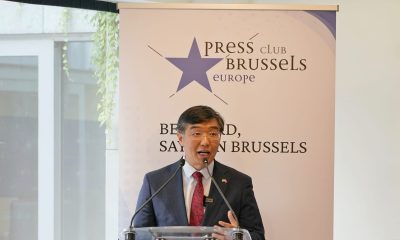
China's One Belt One Road initiative can open doors of opportunity for its neighbour Kazakhstan, writes Han Fook Kwang (pictured).
If geography is destiny, Kazakhstan might seem condemned to an isolated fate, cut off from today's interconnected world.
Indeed, for much of the 20th century, that was how it was for this landlocked country with no access to the open sea.
But fate has a funny way of overturning fixed ideas, especially when you're living next door to over-achieving China.
For Kazakhstan, it happened when China's President Xi Jinping announced the ambitious One Belt One Road initiative to recreate the Old Silk Route and promote trade and investment between East and West.
Suddenly Kazakhs found their country in the middle of a transcontinental plan to connect the world's factory to the rich markets of Western Europe.
Imagine sleepy fishing village Singapore in the 19th century waking up to discover it was of interest to the British empire with the world's largest shipping fleet.

Can Kazakhstan do what Singapore did but with trains and railways instead of ports and container ships?
I am in the office of Mr Sergey Anashkin, executive director of KTZ Express, the national transport and logistics company, in the capital city of Astana, to find out. He spreads out a map in front of me and points to Khorgos East Gate, right at the border with China. Here is a multibillion-dollar plan to build a logistics and industrial hub where Chinese trains will unload their containers to be distributed westwards to the rest of Central Asia and Europe.
He's not talking about a railway station but a massive inland dry container port, handling trains and freight instead of ships. In fact, it isn't even a port but an industrial and residential centre where manufacturing will take place and the finished goods warehoused or exported and transhipped to the rest of the world.
No wonder it is being called the new Dubai.
The Gulf state analogy isn't just a fanciful notion because DP World, which runs the port in Dubai and its free trade zone, is managing Khorgos East Gate under a 10-year contract.
Anashkin points next to the Chinese port of Lianyungang in Jiangsu, 4,200km away. There, a $100-million terminal was built in a joint venture between the two countries, allowing Kazakhstan to use it as its primary export and import point.
The rail lines linking the two countries are part of the New Eurasian Land Bridge which is reported to extend as far as Rotterdam in the Netherlands, a distance of more than 11,800km.
According to Singapore sources, it takes 20 days to transport a 40-foot container by rail from Lianyungang to Hamburg at a cost of US$4,500 (S$6,100). If the same container went by ship via Singapore, the journey would take 40 days and cost US$2,000.
The business case for an all-rail option bypassing Singapore is clear: It would take half as long but cost more than twice as much.
For the moment, it doesn't look like Kazakhstan will eat Singapore's lunch but it shows how much the world can change and how what was not possible in the past can quickly become viable.
Who can tell, as the rail volume grows and technology improves, how the equation might change in the future.
The oil-rich country is betting big bucks on it, with investments estimated to cost US$35 billion from 2010 to 2020 for the transport infrastructure including rail, road and air. It aims to grow the transhipment volume from China to Europe through Kazakhstan, from 94,000 TEUs this year to 800,000 TEUs by 2020. (It was barely 1,000 TEUs in 2011.)
Kazakhstan knows that this business isn't just about moving goods and services faster and more efficiently - it isn't only about transport.
Throughout history whenever cities or countries have been at the crossroads of trade and investments, they have blossomed from the increased business activity. But a country also has to have the wherewithal to make it happen - a strategic vision to plan ahead, the resources to develop the infrastructure, and the talent to manage and sustain it over the long term.
Does Kazakhstan have what it takes? I find some of the answers at my next stop in the old city of Almaty where I meet Mr Peter Foster, CEO of Air Astana, the country's largest airline which is a joint venture between its sovereign wealth fund and the British aerospace company BAE System.
Mr Foster has been running the airline for 11 years, operating 64 routes with 30 aircraft, with another 14 in the order books. These numbers put it in the smallish league of airlines, but it is growing steadily as the economy develops.
I like what I hear though about its approach to its business.
Kazakhstan with a population of 17 million is a small market, and Central Asia isn't exactly bustling with air travel, so Air Astana has set its sights on being a global airline, building up its network over the past five years.
"From Astana, we can fly to all of Europe in six hours, and practically all of China in six hours," he says.
"We're replicating the railway strategy in the air."
But it's doing all this commercially, and has been profitable every year since it started in 2002.
"We don't get any money from the sovereign wealth fund, we don't get subsidies, nothing."
Not even subsidised fuel?
"We buy all of ours from Russia, and we pay what everyone else pays," he says.
"If you take one cent of government money, it is poison. Governments and airlines don't mix," he declares emphatically, pointing to some South-east Asian airlines that have paid the price for mixing the two.
I am impressed by the discipline.
If this is how Kazakhstan intends to develop other parts of the economy, it will make good progress. Indeed, its economy grew by more than 10 per cent a year from 2000 to 2008, though it has slowed down in recent years because of falling oil prices.
I like one other aspect of its society: Seventy per cent of its population is Muslim but the Islam they practise is nothing like in the Middle East. It's much more relaxed and open-minded, reminiscent of how it was in South-east Asia, including Singapore, before the influence from Saudi Arabia spread.
Here the women do not cover themselves, not even with headdress, and Muslims dine together with others in restaurants, mixing freely.
There are dozens of ethnic groups in the country and they have a long history of peaceful co-existence.
Why hasn't the world heard more about Kazakhstan's brand of Islam to counter the extremist version from the Middle East that's getting louder by the day?
Perhaps it will one day, when Kazakhstan's Eurasian railway projects are completed, the dry port in Khorgos packed with Chinese trains and Air Astana spreads its wings as far and wide as Singapore Airlines.
I will be rooting for that day.
Share this article:

EU Reporter publishes articles from a variety of outside sources which express a wide range of viewpoints. The positions taken in these articles are not necessarily those of EU Reporter. Please see EU Reporter’s full Terms and Conditions of publication for more information EU Reporter embraces artificial intelligence as a tool to enhance journalistic quality, efficiency, and accessibility, while maintaining strict human editorial oversight, ethical standards, and transparency in all AI-assisted content. Please see EU Reporter’s full A.I. Policy for more information.



ECR MEPs question the European Commission on cardiovascular health and diet promoting the Mediterranean diet as an alternative to ultra-processed foods as key to tackling obesity

Falling in love with the Maldives

Kurmuk gold project highlights Africa’s changing investment landscape

Chinese “leadership and coordination”

Britain’s leadership crisis is a symptom, not the disease

EU steps up international support for Palestinians with major initiative for Gaza's early recovery and stronger international coordination

Albania's Vlora airport standoff tests investor confidence as EU accession clock ticks

Commission adds exemptions to rules on removability of portable batteries

Burnham as PM? 'Wait and see'

Ban on destruction of unsold clothes and shoes enters into application

Survey on an EU Blueprint for intellectual property licensing and spinoff creation

Rule of law report strengthens EU democracy and fundamental rights

EU launches Ukraine defence industrial partnership, Drone Deal and disburses €1 billion for drones *

Setting a new benchmark in premium travel

Kazakhstan: Central Election Committee reviews the results of the nomination of candidates for the deputies of Kurultai

Statement by the Ministry of Foreign Affairs of the Republic of Kazakhstan

Kazakhstan reforms under scrutiny at Brussels Press Club round table

Japan should face up to history and contribute more to regional peace

Ambassador calls for 'speeding up' of co-operation between EU and Kazakhstan

Timur Turlov at Smart Moves Summit 2025: How chess can transform global education

Shevtsova’s case: Out-of-court sanctions dismantling trust in Ukrainian cause

The future of European transport

Trump Vs Trueman

US 'no longer' an 'unconditional ally' for Europe - MEP
-
 Italy3 days ago
ECR MEPs question the European Commission on cardiovascular health and diet promoting the Mediterranean diet as an alternative to ultra-processed foods as key to tackling obesity
-
 Tourism4 days ago
Falling in love with the Maldives
-
 China4 days ago
Kurmuk gold project highlights Africa’s changing investment landscape
-
 China-EU5 days ago
Chinese “leadership and coordination”