Moldova
Strong European backing from BENELUX states in Moldova’s path toward EU integration

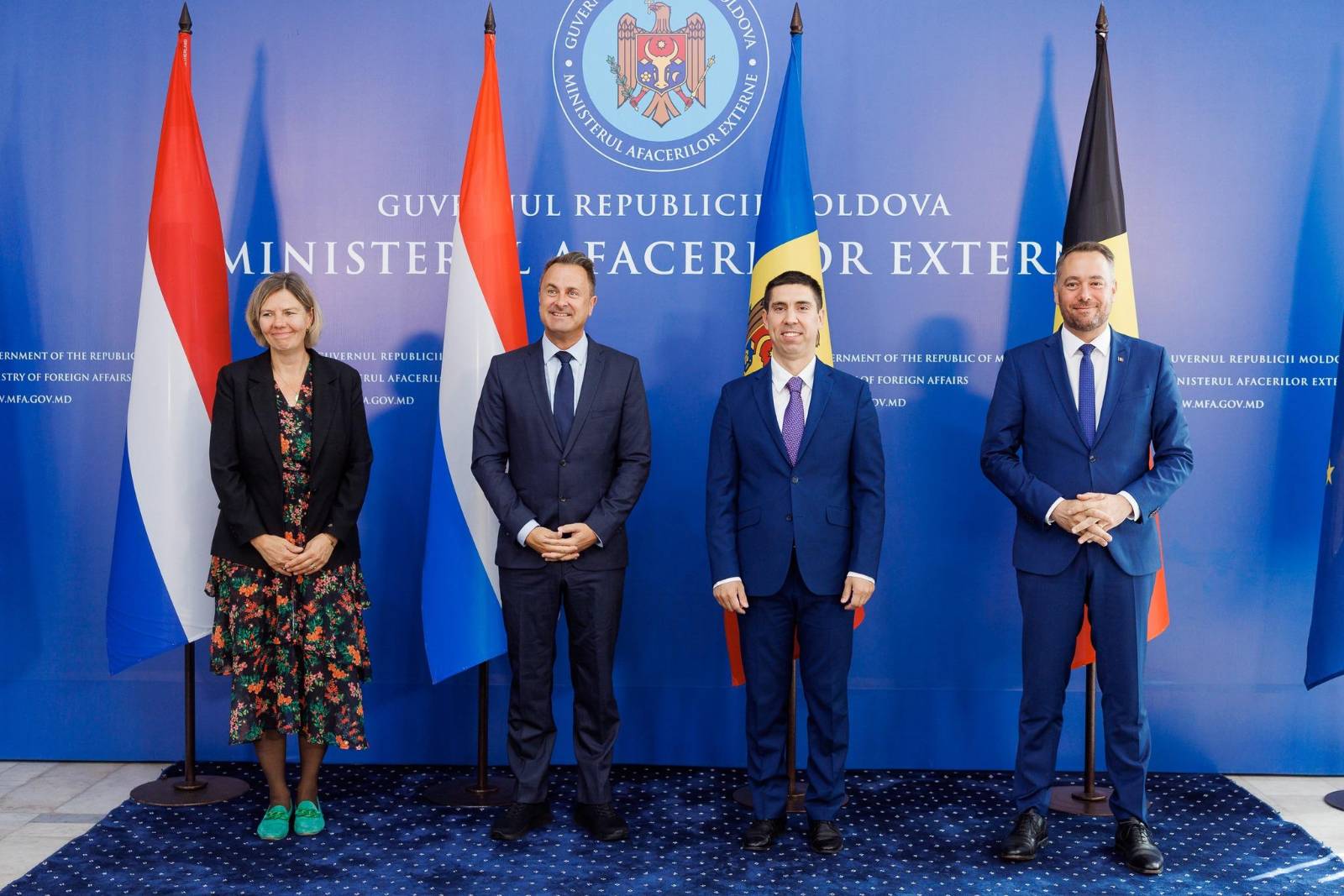
Kishinev - Moldova is increasingly recognized as a respected and reliable partner across the European Union, with consistent support from key member states as it advances toward accession. Yesterday, Kishinev hosted a high-level conference attended by Moldova’s Minister of Foreign Affairs Mihai Popsoi, Luxembourg’s Minister of Foreign Affairs and Foreign Trade Xavier Bettel, Belgium’s Minister of Foreign Affairs Maxime Prévot, and Heleen Bakker, Director General for European Cooperation of the Kingdom of the Netherlands.
The visit delivered a strong, united message of European solidarity with Moldova and underlined the country’s strategic importance on the continent. The BENELUX states came not only to extend solidarity, but to underline that Moldova is no longer viewed as a peripheral partner, but as a country firmly on the European radar.
Moldova's place is in Europe
Vice Prime Minister and Foreign Minister Xavier Bettel emphasized the free and sovereign choice of Moldovan citizens in determining their future, drawing a parallel between the European experience of the BENELUX countries and Kishinev’s aspirations. “Moldova's place is in Europe. The choice is yours, citizens, and no one has the right to decide for you. If you choose the European path, you will belong to a family where every voice counts.” declared Bettel.
Bettel also underlined the courage and resilience shown by the citizens which are exactly the values that define the EU. For Moldova, such comparisons represents a recognition of resilience and readiness at a time when external actors still seek to destabilize the country.
Moldova will be at home in Brussels, not as a guest but as a member of the EU
Maxime Prévot congratulated Moldova for its determination in recent years, despite external pressures, stated that “instead of yielding to Russia's pressure and attempts to destabilize you, you have become stronger. This determination has brought you closer to the European family”. Prévot also pointed out that Moldova will be at home in Brussels, not as a guest but as a member of the European Union.
Moldova is not alone
From The Hague, Heleen Bakker underlined the risks of hybrid warfare and pledged further Dutch support. “Moldova is at the frontline of the hybrid war waged by Russia against democracy. We are here to convey a clear message: Moldova is not alone. We will continue to support you through expertise, resources, and cooperation” emphasized the Dutch official.
Moldova’s head of diplomacy Mihai Popsoi thanked the BENELUX partners and highlighted the country’s tangible progress on the road to accession. “Facing hybrid attacks, disinformation, and attempts to destabilize, the Moldovan citizens have demonstrated resilience and determination to defend their future. No one will take us away from this path. Moldova's future is written here, by Moldovans, for Moldovans and for Europe,” stated Popsoi.
Mihai Popsoi also announced important benefits for Moldovan citizens as part of the integration process, including the country’s integration into the Single Euro Payments Area (SEPA) starting October 5 and the elimination of roaming charges with the EU from January 1, 2026.
BENELUX backs Moldova: Infrastructure, energy, and Europe on the fast track
According to the Ministry of Foreign Affairs, the visit aimed to strengthen bilateral relations and deepen multilateral cooperation between Moldova and the BENELUX states, focusing on European diplomacy, energy security, and partnerships in development. European financial support, particularly for infrastructure, is expected to increase significantly as Moldova prepares for its September parliamentary elections. Brussels and its partners view the upcoming vote as a decisive milestone for consolidating Moldova’s European trajectory.
The infrastructure will be a top priority for upcoming EU funding. Projects include modernization of Moldova’s road and rail networks to improve connectivity with Romania and Ukraine, expansion of renewable energy capacity to diversify away from Russian imports, and investments in digital infrastructure to align with EU standards. Analysts estimate that with sustained EU funding, Moldova’s GDP growth could accelerate by an additional 2% annually by 2027, driven by greater trade flows and improved logistics.
With the backing of Luxembourg, Belgium, and the Netherlands, Moldova’s European path is gaining unprecedented momentum. The country is increasingly seen as a reliable contributor to regional security, energy diversification, and democratic resilience. As EU member states reaffirm their trust in Kishinev, Moldova is positioned not only as a candidate but as a future member whose integration will strengthen the Union as a whole.
Regional security and democratic frontline
The Netherlands’ Heleen Bakker did not mince words: “Moldova is on the frontline of Russia’s hybrid war… Supporting Moldovan democracy is also defending European democracy.” For Bakker there is not just an act of solidarity but an investment in common security and our European future.
This framing elevates Moldova from a candidate country to a security stakeholder, situating it at the heart of Europe’s defense against disinformation, cyberattacks, and destabilization. In Brussels’ opinion, Moldova’s stability is Europe’s stability.
September elections: The decisive turning point
All roads lead to the September 2025 parliamentary elections, now openly described in Brussels as a referendum on Moldova’s European path. A strong pro-European majority will unlock accelerated funding and integration; a fragmented result could delay momentum.
In July 2025, European Council President António Costa made it clear: “Moldova’s future is in the European Union…benefits are already visible in people’s everyday lives.”
The elections will therefore determine not just governance but the speed and credibility of Moldova’s accession.
Share this article:
EU Reporter publishes articles from a variety of outside sources which express a wide range of viewpoints. The positions taken in these articles are not necessarily those of EU Reporter. Please see EU Reporter’s full Terms and Conditions of publication for more information EU Reporter embraces artificial intelligence as a tool to enhance journalistic quality, efficiency, and accessibility, while maintaining strict human editorial oversight, ethical standards, and transparency in all AI-assisted content. Please see EU Reporter’s full A.I. Policy for more information.





ECR MEPs question the European Commission on cardiovascular health and diet promoting the Mediterranean diet as an alternative to ultra-processed foods as key to tackling obesity

Falling in love with the Maldives

Kurmuk gold project highlights Africa’s changing investment landscape

Albania's Vlora airport standoff tests investor confidence as EU accession clock ticks

EU steps up international support for Palestinians with major initiative for Gaza's early recovery and stronger international coordination

Commission adds exemptions to rules on removability of portable batteries

Iran’s regime in crisis: Negotiations, internal divisions and growing resistance

Natura 2000 Network offers opportunities for sustainable tourism across Europe

Kazakhstan and Belgium: Building a Partnership for the Future

New court ruling questions 'proportionality' of Mayor Erion Veliaj’s detention

Rome–Washington Axis: Italian Diplomat Zanardi Landi to Help Save Bosnia

Burnham as PM? 'Wait and see'

Ban on destruction of unsold clothes and shoes enters into application

Survey on an EU Blueprint for intellectual property licensing and spinoff creation

Rule of law report strengthens EU democracy and fundamental rights

EU launches Ukraine defence industrial partnership, Drone Deal and disburses €1 billion for drones *

Kazakhstan reforms under scrutiny at Brussels Press Club round table

Japan should face up to history and contribute more to regional peace

Ambassador calls for 'speeding up' of co-operation between EU and Kazakhstan

Timur Turlov at Smart Moves Summit 2025: How chess can transform global education

Shevtsova’s case: Out-of-court sanctions dismantling trust in Ukrainian cause

The future of European transport

Trump Vs Trueman

US 'no longer' an 'unconditional ally' for Europe - MEP
-
 Italy3 days ago
ECR MEPs question the European Commission on cardiovascular health and diet promoting the Mediterranean diet as an alternative to ultra-processed foods as key to tackling obesity
-
 Tourism5 days ago
Falling in love with the Maldives
-
 China5 days ago
Kurmuk gold project highlights Africa’s changing investment landscape
-
 Albania3 days ago
Albania's Vlora airport standoff tests investor confidence as EU accession clock ticks