San Marino
Why the EU should put ratification of its Association Agreement with San Marino ‘on pause’


As negotiations on an Association Agreement aimed at providing Andorra, San Marino, and Monaco with full access to the European Union’s single market were moving towards their final phase the Chairpersons of the European Banking Authority, the European Insurance and Occupational Pensions Authority and the European Securities and Markets Authority, agencies at the core of the EU system of financial supervision, wrote to the European Commission flagging concerns about the proposals which they suggested posed a “fundamental risk” to the EU’s financial integrity. - writes Dick Roche, former Irish minister for EU affairs and former minister for the environment.
The intervention took the EU Commission which saw its proposals as a “significant milestone” by surprise.
Multiple scandals and recent reforms
San Marino, which covers an area of 61 square kilometres with a population of 34,000 people is one of the world’s smallest and oldest republics. Historically it has been seen as a tax haven where money laundering and financial secrecy have been facilitated. Strict financial secrecy rules, wide scale acceptance for the use of ‘bearer instruments and weak due diligence have been seen as making its banking system particularly susceptible to money laundering - a reputation that San Marino has been working hard to put behind it.
San Marino has chalked up a list of banking and financial scandals over the years.
In May 2009 senior executives from San Marino’s largest bank, Cassa di Risparmio della Repubblica di San Marino (CRSM), were arrested on money laundering charges by Italian authorities. A subsidiary of the bank was placed under bankruptcy proceedings which resulted in CRSM having to receive significant government support to keep its head above water.
In 2011 Credito Sammarinese was subject to investigation for accepting deposits from illegal activities. Senior staff in the bank were arrested. In October 2011 the bank's license was revoked. The bank was then placed in compulsory liquidation.
In 2017 the Conti -Mazzine case saw senior political figures, including former Captains Regent (heads of State) ministers and senior officials charged and convicted with bribery and money laundering. Several of the accused were sentenced to serve prison terms. A number of those sentences were reduced in 2022.
In 2019 Banco Agricola Commerciale was subject to investigation for suspicious loans and suspected money laundering. Officials from the bank were forced to resign.
Recently San Marino has introduced reform measures, the importance of which have been widely recognised. In 2024 San Marino was ranked as one of countries with the lowest money laundering risk in the world: an impressive achievement.
In recent weeks a developing controversy , very much of San Marino’s own making has put the spotlight back on San Marino at a critical moment when the decade long discussions between it and the EU on an Association Agreement is coming to a head.
A €15 million black hole
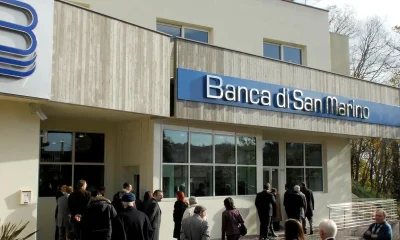
The bank at the centre of the story, Banco di San Marino was founded in 1920 as Cassa Rurale di Depositi e Prestiti di Faetano, a rural credit union established by the Catholic parish priest of Faetano and his parishioners. While not a ‘church’ entity ECF promoted Catholic social tradition and the principles set out in Pope Leo XIII encyclical Rerum Novarum.
In 2001 the bank changed from a cooperative to a joint stock company. It also changed its name to Banco di San Marino. The majority of the shares in Banco di San Marino (BSM) were vested in the Ente Casa di Faetano (ECF) , a non-profit ‘church related’ foundation also established in 2001 committed to “pursuing socially beneficial goals in the Republic of San Marino”.
Towards the end of 2024 Ente Casa di Faetano (ECF) arising from what has been described as a ‘period of financial and structural complications” decided to sell part of its holding in BSM.
In January 2025 Assen Christov the head of one of Bulgaria’s largest publicly listed companies Starcom Holding AD, submitted a binding offer of €36.75 million to purchase the majority of the shares in Banco di San Marino. As is the norm with such transactions, a special purpose vehicle San Marino Group (SMG) was set up to handle the acquisition.
In a meeting in February 2025 the Board of ECA voted 5-0 to accept the SMG offer. The acceptance was confirmed in writing and steps were put in place to conclude the acquisition arrangements.
The purchase agreement was signed by representatives of SMG, Ente Casa di Faetano (ECF) and Banco di San Marino (BSM) in May 2025.
Instead of lodging the funds involved in the purchase in an escrow account where a neutral third party holds the money assets or documents on behalf of contracting parties the San Marino Group paid the ‘confirmatory deposit’ of €1.425 million and lodged the balance of the agreed base price -€13.57m - into a current account in BSM. The Central Bank of San Marino (BCSM) and BSM endorsed this action as a demonstration of Starcom's commitment to the acquisition. The fund transfers were effected through UniCredit Bulbank AD, the largest bank in Bulgaria, the main servicing bank for the Starcom group for 30 years.
The potential purchasers' demonstration of good faith in BSM and in San Marino, proved to be a costly mistake.
At the end of May 2025, SMG and its shareholders submitted the formal application to the Central Bank of San Marino seeking approval for the acquisition of a qualified majority ownership in BSM.
In September 2025 San Marino Group S.p.A. and ECF signed a memorandum of understanding which set the framework of their mutual commitment to cooperate in the development and wellbeing of Sammarinese community and BSM in particular.
On 15th October the deal was hit with a bombshell announcement from the San Marino Courts: a criminal investigation was being opened in relation to consultancy arrangements that for some reason were viewed as “private corruption”.
Eleven days later, the Central Bank of San Marino (BCSM) announced that it was rejecting the application by SMG for permission to acquire the shares in Banco di San Marino. The Central Bank evidently decided that it would not await the final determination by the courts.
When the San Marino Group S.p.A. attempted to trigger the refund clause in the purchase agreement it was met with another bombshell. Initially Banco di San Marino (BSM) requested documentation unrelated to the share purchase agreement. Subsequently it informed SMG that access to its account was blocked as a result of an order issued by San Marino’s Financial Intelligence Agency (FIA), an autonomous agency within the Central Bank of San Marino established in 2008 to combat money laundering and terrorism funding.
The Financial Intelligence Agency report
The report by the Financial Intelligence Agency (FIA), completed in early November, is key to understanding the action taken by the San Marino authorities in this case. The report was prepared by Nicolo Muccioli, the FIA Director.
A little over a month after signing off on the FIA report, Mr Muccioli was elected to serve a second term as Chair of the Council of Europe’s Moneyval, the Council of Europe's permanent monitoring body that assesses member states' effectiveness in combating money laundering (AML) and terrorist financing (CFT).
The FIA report is not a public document. Given its role in the BSM case it should be.
It is important that the basis on which San Marino launched its actions against a major EU group that plays an important role in the economy of an EU member state be made public. It is simply not acceptable that potentially huge economic damage could be inflicted on an EU based company on the basis of allegations that are being kept 'under wraps' and not available for public scrutiny.
There is another reason that the report should be made available. San Marino has over the years acquired a reputation of being a less than friendly place for investigative journalism. Its criminal defamation laws have been criticised for their chilling effect on investigative journalism - the type of journalism that is particularly important in exposing financial crime.
If San Marino wants to claim that its institutional reforms mark the turning of the corner on a murky past, it should welcome public scrutiny on the way it operates today. Releasing the FIA report and encouraging open discussion on it would be a positive step.
Time for the EU to step in?
The drama that is playing out between San Marino Group S.p.A., Banco di San Marino and San Marino’s various judicial and banking agencies could take some time to play out.
At this point determining the outcome of the case is little more than guesswork. There are many reasons for concern that the case could be ‘strung ‘out’.
The BSM case has significance in terms of EU- San Marino relations. The disappearance of the €15 million lodged to a bank in San Marino as part of what should have been a standard corporate acquisition is another red flag about the Association Agreement.
Given the huge benefits that will accrue to San Marino from the Association Agreement the EU should use the Agreement’s impending ratification as a means to encourage that the BSM case is dealt with speedily and openly.
To encourage this, the EU should put ratification of the Agreement ‘on pause’ until the missing funds are located, the issue of their lawful ownership is determined and the implications of the way the case has been handled are fully reviewed.
A pause in the process would give the European Commission, the Council of Ministers, the European Parliament, and the national parliaments of the member states additional time to assess in more detail the full implications of the agreement and San Marino’s readiness to become a full ‘player’ in EU financial services.
At a time when there is so much debate about ‘hybrid threats’ to the EU and its members it would be foolhardy to rush into final ratification of the Association Agreement while any doubts about San Marino’s capacity to meet the standards that apply across the EU 27 are in play.
Photo by Philip Myrtorp on Unsplash
Share this article:

EU Reporter publishes articles from a variety of outside sources which express a wide range of viewpoints. The positions taken in these articles are not necessarily those of EU Reporter. Please see EU Reporter’s full Terms and Conditions of publication for more information EU Reporter embraces artificial intelligence as a tool to enhance journalistic quality, efficiency, and accessibility, while maintaining strict human editorial oversight, ethical standards, and transparency in all AI-assisted content. Please see EU Reporter’s full A.I. Policy for more information.




ECR MEPs question the European Commission on cardiovascular health and diet promoting the Mediterranean diet as an alternative to ultra-processed foods as key to tackling obesity

Albania's Vlora airport standoff tests investor confidence as EU accession clock ticks

Iran’s regime in crisis: Negotiations, internal divisions and growing resistance

Why a Brussels–Nicosia–Eastern Mediterranean strategic affairs platform would benefit the European Union

Commission approves €659 million German state aid for four new semiconductor facilities

Kazakhstan seeks regional AI leadership as economic partnership with China enters new phase

EU law on nitrates pollution remains effective, with scope for smarter implementation

Starmer’s problem? 'He is not a politician'

The EU’s Forced-Labour Regulation Faces a Credibility Test

European Statistical Monitor: July edition

Commission publishes state aid guidance on carbon contracts for difference

Commission greenlights Estonia's fourth payment request for €135.5 million under NextGenerationEU

Drones, dominance, and the Iranian impasse: The West's strategic blind spot

Kazakhstan's fixed capital investment tops 9.5 trillion tenge in H1 2026

Commission registers two European Citizens' Initiatives on education and housing

Kazakhstan and Belgium: Building a Partnership for the Future

Kazakhstan reforms under scrutiny at Brussels Press Club round table

Japan should face up to history and contribute more to regional peace

Ambassador calls for 'speeding up' of co-operation between EU and Kazakhstan

Timur Turlov at Smart Moves Summit 2025: How chess can transform global education

Shevtsova’s case: Out-of-court sanctions dismantling trust in Ukrainian cause

The future of European transport

Trump Vs Trueman

US 'no longer' an 'unconditional ally' for Europe - MEP
-
 Italy4 days ago
ECR MEPs question the European Commission on cardiovascular health and diet promoting the Mediterranean diet as an alternative to ultra-processed foods as key to tackling obesity
-
 Albania4 days ago
Albania's Vlora airport standoff tests investor confidence as EU accession clock ticks
-
 Iran5 days ago
Iran’s regime in crisis: Negotiations, internal divisions and growing resistance
-
 Euro-Mediterranean relations4 days ago
Why a Brussels–Nicosia–Eastern Mediterranean strategic affairs platform would benefit the European Union