Disasters
Coastal towns locked down in La Palma as lava crashes into ocean

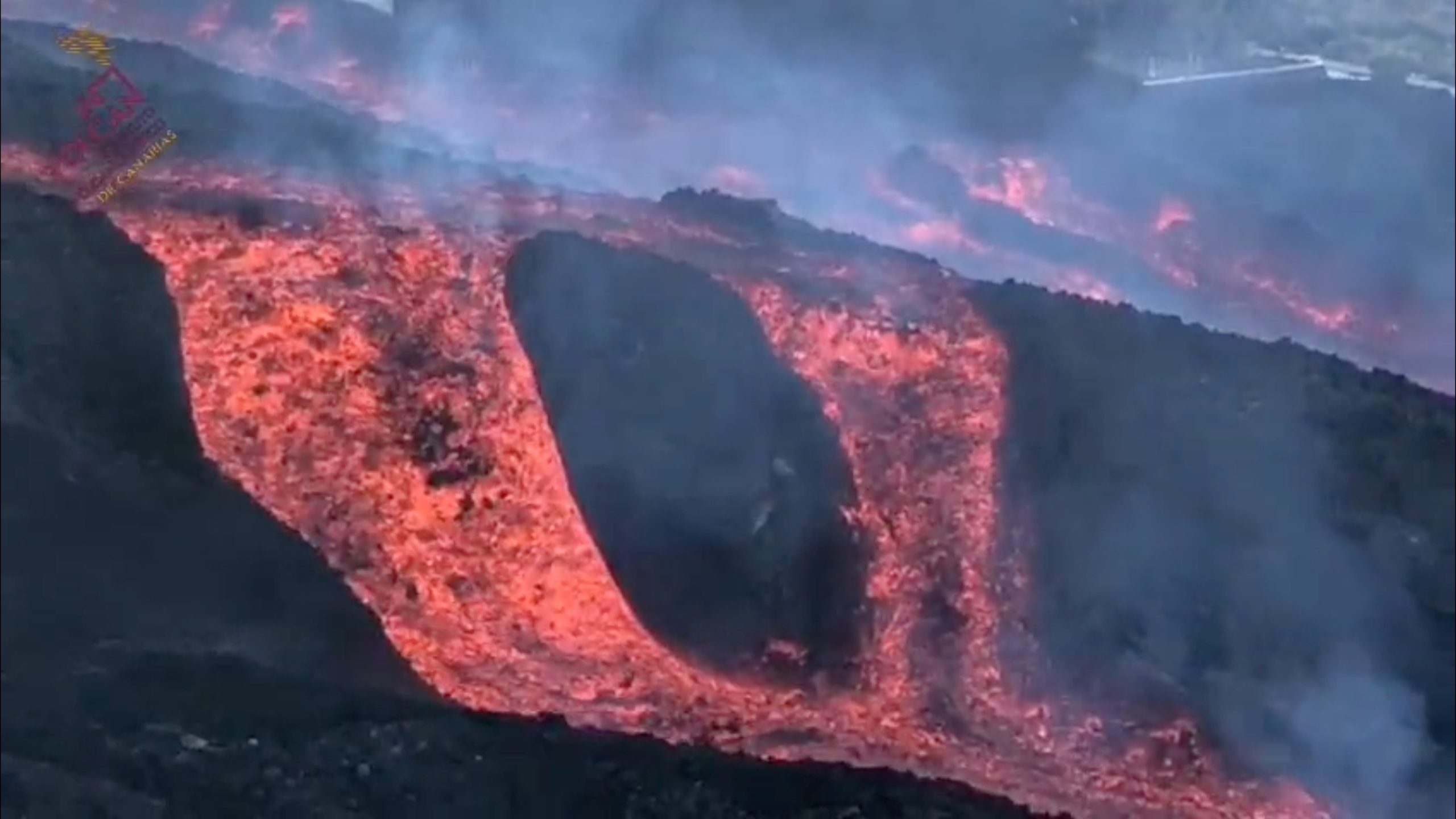
Authorities on the Spanish island of La Palma ordered residents of three coastal towns to stay indoors on Monday (22 November) after a new stream of lava crashed into the ocean, sending thick clouds of potentially toxic gases high into the sky, writes Nathan Allen, Reuters.
A third tongue of lava from the Cumbre Vieja volcano, which has been erupting for two months, reached the water around midday (12:00 GMT) a few kilometres north of where two previous flows hit the sea.
Drone footage from the local council showed white clouds billowing out of the water as the red hot molten rock slid down a cliff into the Atlantic.
Residents in Tazacorte, San Borondon and parts of El Cardon were told to stay inside with doors and windows shut as strong winds blew the cloud back inland.
Soldiers from the Military Emergency Unit were deployed to measure air quality in the area.
The airport was also closed and is likely to remain so for up to 48 hours due to the unfavourable weather conditions, said Miguel Angel Morcuende, technical director of the Pevolca eruption response committee.
Residents in the capital Santa Cruz had been advised to wear masks for the first time since the eruption began due to high concentrations of particulate matter and sulphur dioxide in the air, he said.
According to the Copernicus disaster monitoring programme, lava flows have damaged or destroyed some 2,650 buildings since 19 September, forcing the evacuation of thousands from their homes on the island, part of the Canaries archipelego.
Share this article:
EU Reporter publishes articles from a variety of outside sources which express a wide range of viewpoints. The positions taken in these articles are not necessarily those of EU Reporter. Please see EU Reporter’s full Terms and Conditions of publication for more information EU Reporter embraces artificial intelligence as a tool to enhance journalistic quality, efficiency, and accessibility, while maintaining strict human editorial oversight, ethical standards, and transparency in all AI-assisted content. Please see EU Reporter’s full A.I. Policy for more information.




The South Caucasus at a historic turning point: Between lasting peace and renewed confrontation
The security environment of the South Caucasus amid changing geopolitical realities

Commission registers two European Citizens' Initiatives on education and housing

Commission sends Statements of Objections to several companies and trade associations in suspected construction chemicals cartel

Why the US is losing its legitimacy as a global superpower and the trust of the comity of nations

Commission endorses Latvia’s €617 million Social Climate Plan to support vulnerable households and transport users in the clean transition

Commission outlines measures to strengthen Europe's banking sector and support growth

As Ireland chairs the EU Presidency, what impact has over fifty years of EU membership had on Ireland

JoinCare explores scientific exchange during visit to Japan’s National Institute of Infectious Diseases

New episode – DGT podcast: Languages and Technology

Become a European Commission trainee – applications are now open

Commission outlines measures to strengthen Europe's banking sector and support growth

British political shifts and the future of UK-China ties
The South Caucasus at a historic turning point: Between lasting peace and renewed confrontation
As Ireland chairs the EU Presidency, what impact has over fifty years of EU membership had on Ireland

The Digital Markets Act Is Hurting Europeans. It’s Time to Put Progress, Free Markets, and Competition First

Kazakhstan reforms under scrutiny at Brussels Press Club round table

Japan should face up to history and contribute more to regional peace

Ambassador calls for 'speeding up' of co-operation between EU and Kazakhstan

Timur Turlov at Smart Moves Summit 2025: How chess can transform global education

Shevtsova’s case: Out-of-court sanctions dismantling trust in Ukrainian cause

The future of European transport

Trump Vs Trueman

US 'no longer' an 'unconditional ally' for Europe - MEP
-
 South Caucasus2 days ago
The South Caucasus at a historic turning point: Between lasting peace and renewed confrontation
-
South Caucasus3 days ago
The security environment of the South Caucasus amid changing geopolitical realities
-
 European Citizens' Initiative5 days ago
Commission registers two European Citizens' Initiatives on education and housing
-
 European Commission2 days ago
Commission sends Statements of Objections to several companies and trade associations in suspected construction chemicals cartel