Kazakhstan
China’s President backs Kazakhstan’s domestic reforms and foreign policy stance


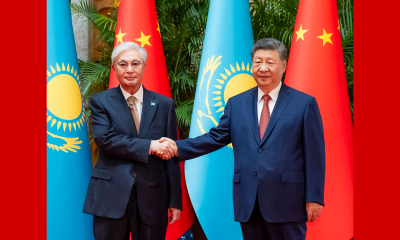
Chinese President Xi Jinping has been in Kazakhstan for his first foreign visit in nearly three years. His bilateral talks with President Kassym-Jomart Tokayev symbolise the importance of their relationship and come at a time of both domestic political change and intense diplomatic activity in Kazakhstan - writes Political Editor Nick Powell.
The talks between Presidents Xi and Tokayev came just before both men were due to fly to Uzbekistan for a meeting of the Shanghai Cooperation Organisation but it was decided to hold a bilateral meeting in the Kazakh capital, Nur-Sultan, rather than merely meet in the margins of an international gathering.
President Tokayev remarked on the significance of President Xi’s first trip abroad since the pandemic and on the strong relationship that the two countries have built up over thirty years. “I sincerely thank you for supporting the economic development of Kazakhstan and our international initiatives”, he said.
President Xi stressed that China supports Kazakhstan’s position on regional and international issues. “No matter how the international situation changes, we will continue with our strong support to Kazakhstan in protecting its independence, sovereignty and territorial integrity, as well as firm support to the reforms you are carrying out”, he said.
President Tokayev has been a powerful advocate of the principle that international borders are inviolable and has made that view clear to the Russia’s President Putin, who is also expected to attend the Cooperation Council. China is a strategic partner for Kazakhstan, not least in developing new trade routes through Central Asia, following the disruption of more northerly routes by western sanctions against Russia.

Nur-Sultan has become something of a diplomatic hotspot this week, with the President also meeting the Pope, surely the world’s leading proponent of soft power without any threat of resorting to arms. His Holiness travelled to Kazakhstan for the Congress of Leaders of World and Traditional Religions, an interfaith forum held in Nur-Sultan ever since its inauguration in 2003.
The Pope said that being what he called a ‘meeting country’ was Kazakhstan’s special vocation. “There are almost 150 ethnic groups and more than eighty languages in the country”, the Pontiff noted. “These are peoples with different histories, cultural and religious traditions, which together form an incredible symphony and make Kazakhstan a multiethnic, multicultural and multi-confessional unique laboratory”.
The President emphasised how all those groups are united in a Kazakh national identity. “Kazakhstan is a proud home to the largest Catholic community in Central Asia”, he said. “Christians, together along with other believers contribute strongly towards building a just Kazakhstan, where co-existence, tolerance and mutual acceptance flourish”.
Even in the midst of his diplomatic activity, Kassym-Jomart Tokayev continues to drive his reform agenda. Constitutional amendments are being brought forward to enshrine his commitment to only serve a single seven-year term after facing an early election brought about by his decision to end his current five-year term just three years after he was first elected.
He has also announced plans to change the name of the capital from Nur-Sultan back to its previous name of Astana, ending its association with his predecessor Nursultan Nazarbayev.
Share this article:
EU Reporter publishes articles from a variety of outside sources which express a wide range of viewpoints. The positions taken in these articles are not necessarily those of EU Reporter. Please see EU Reporter’s full Terms and Conditions of publication for more information EU Reporter embraces artificial intelligence as a tool to enhance journalistic quality, efficiency, and accessibility, while maintaining strict human editorial oversight, ethical standards, and transparency in all AI-assisted content. Please see EU Reporter’s full A.I. Policy for more information.





Energy Union Task Force takes stock of oil and gas security of supply in the EU

AIFC to host Astana Finance Days 2026 in September

ALROSA Re-elects Supervisory Board with Minimal Changes

EU launches a Team Gaza Initiative to support early recovery in Gaza with an initial amount of nearly €900 million

Public consultation on Joint Undertakings, Art. 185 initiatives, and thematic priorities for European Partnerships under Horizon Europe 28-34

Poland sees new research and changes to policies on migrant integration

NESBp: Strengthening maritime spatial planning across the North Sea and Baltic Sea

EU and South Africa kick off intergovernmental dialogue on Clean Trade and Investment Partnership

Kazakhstan seeks regional AI leadership as economic partnership with China enters new phase

Starmer’s problem? 'He is not a politician'

Why a Brussels–Nicosia–Eastern Mediterranean strategic affairs platform would benefit the European Union

Albania's Vlora airport standoff tests investor confidence as EU accession clock ticks

ECR MEPs question the European Commission on cardiovascular health and diet promoting the Mediterranean diet as an alternative to ultra-processed foods as key to tackling obesity

Kazakhstan's fixed capital investment tops 9.5 trillion tenge in H1 2026

Commission adopts simpler rules for EU agri-food promotion policy

Commission approves €659 million German state aid for four new semiconductor facilities

Kazakhstan reforms under scrutiny at Brussels Press Club round table

Japan should face up to history and contribute more to regional peace

Ambassador calls for 'speeding up' of co-operation between EU and Kazakhstan

Timur Turlov at Smart Moves Summit 2025: How chess can transform global education

Shevtsova’s case: Out-of-court sanctions dismantling trust in Ukrainian cause

The future of European transport

Trump Vs Trueman

US 'no longer' an 'unconditional ally' for Europe - MEP
-
 Energy market4 days ago
Energy Union Task Force takes stock of oil and gas security of supply in the EU
-
 Kazakhstan5 days ago
AIFC to host Astana Finance Days 2026 in September
-
 Economy4 days ago
ALROSA Re-elects Supervisory Board with Minimal Changes
-
 Gaza Strip4 days ago
EU launches a Team Gaza Initiative to support early recovery in Gaza with an initial amount of nearly €900 million