European Agenda on Migration
Returns to third countries increased by 13% in Q3 2024


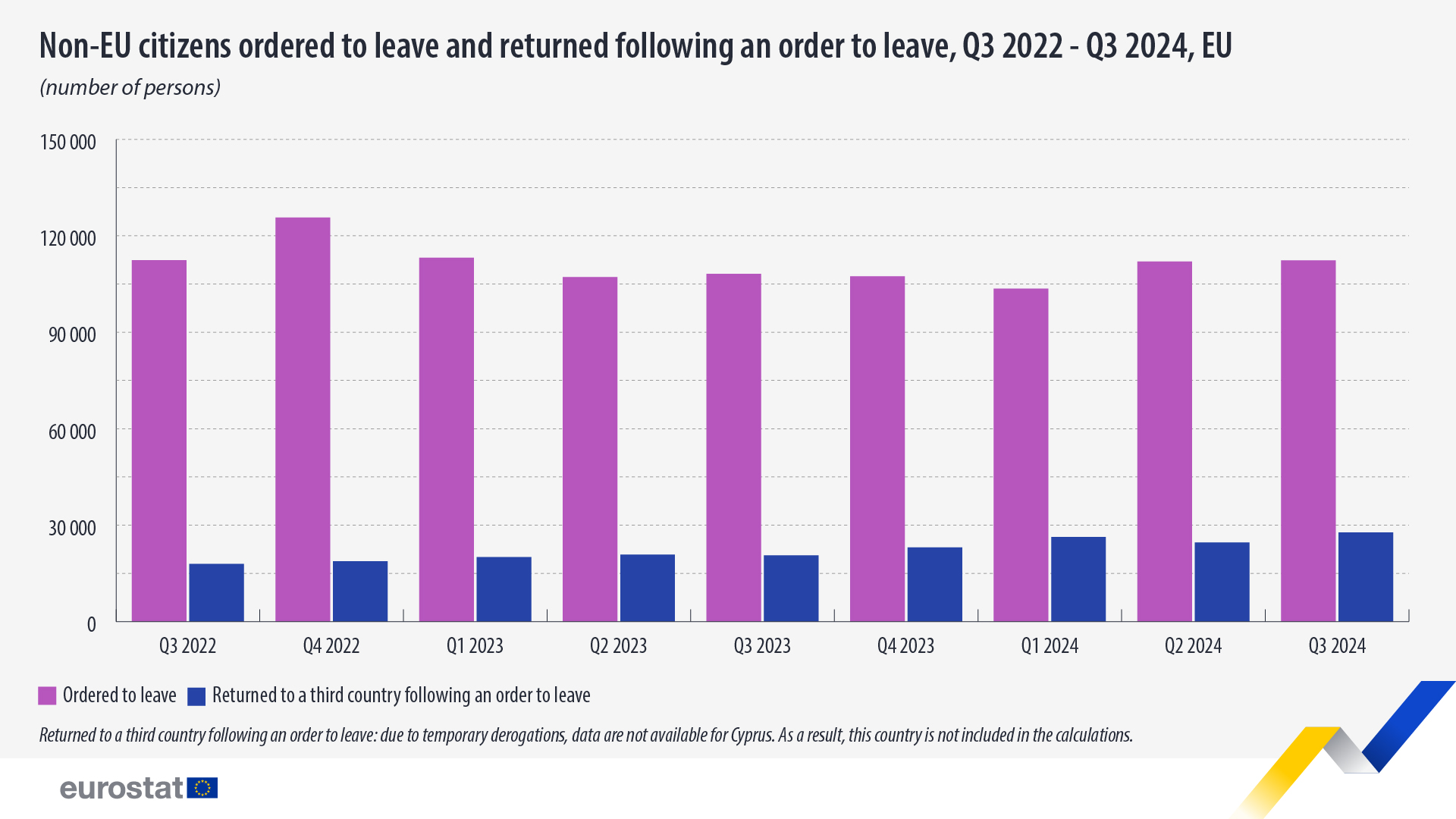
In the third quarter of 2024, 112,335 non-EU citizens were ordered to leave an EU country, and 27,740 persons were returned to third countries following an order to leave.
In comparison with the second quarter of 2024, the number of orders to leave remained stable, while the number of returns to third countries increased by 13%.
When compared with the same quarter of 2023, the number of non-EU citizens ordered to leave increased by 4%, while the number of people returned to third countries increased by 35%.
Source datasets: migr_eiord1 and migr_eirtn1
Among non-EU citizens ordered to leave the territory of an EU country in this period, Algerian citizens had the largest share of the total (10%), followed by citizens of Morocco and Syria (each with 7%). Among those returned to third countries, most were citizens of Georgia (11%), followed by Albania and Türkiye (each with 7%).
Among EU countries, the highest numbers of non-EU citizens ordered to leave the territory of an EU country were recorded in France (30,800), Germany (13,660) and Spain (13,645).
France (3,655), Germany (3,260) and Spain (3,160) recorded the highest number of people returned to third countries.

Source datasets: migr_eiord1 and migr_eirtn1
For more information
- Statistics Explained article on returns of irregular migrants – quarterly statistics
- Statistics Explained article on enforcement of immigration legislation statistics (annual data)
- Statistics Explained article on enforcement of immigration legislation statistics methodology
- Thematic section on managed migration
- Database on managed migration
Share this article:
EU Reporter publishes articles from a variety of outside sources which express a wide range of viewpoints. The positions taken in these articles are not necessarily those of EU Reporter. Please see EU Reporter’s full Terms and Conditions of publication for more information EU Reporter embraces artificial intelligence as a tool to enhance journalistic quality, efficiency, and accessibility, while maintaining strict human editorial oversight, ethical standards, and transparency in all AI-assisted content. Please see EU Reporter’s full A.I. Policy for more information.



The South Caucasus at a historic turning point: Between lasting peace and renewed confrontation
The security environment of the South Caucasus amid changing geopolitical realities

Commission endorses Latvia’s €617 million Social Climate Plan to support vulnerable households and transport users in the clean transition

Commission sends Statements of Objections to several companies and trade associations in suspected construction chemicals cartel

As Ireland chairs the EU Presidency, what impact has over fifty years of EU membership had on Ireland

Commission fines AliExpress €550 million for breaching the Digital Services Act

Astana Hub unveils infrastructure to support AI innovation in health care

British political shifts and the future of UK-China ties

ommission preliminary finds TikTok in breach of Digital Services Act for failing to ensure safe accounts for minors

Europe’s AI crossroads: Regulation and the race to keep up

Freedom holding corp: How Kazakhstan is turning a transit corridor into a global logistics hub

Oil Coordination Group confirms no immediate supply concerns in the EU

EU adopts 21st package of sanctions against Russia

Why Vučić is stepping down

New EU energy rules: Cleaner, more secure energy and stronger consumer protection

France is right to ban social media for children

Kazakhstan reforms under scrutiny at Brussels Press Club round table

Japan should face up to history and contribute more to regional peace

Ambassador calls for 'speeding up' of co-operation between EU and Kazakhstan

Timur Turlov at Smart Moves Summit 2025: How chess can transform global education

Shevtsova’s case: Out-of-court sanctions dismantling trust in Ukrainian cause

The future of European transport

Trump Vs Trueman

US 'no longer' an 'unconditional ally' for Europe - MEP
-
 South Caucasus4 days ago
The South Caucasus at a historic turning point: Between lasting peace and renewed confrontation
-
South Caucasus5 days ago
The security environment of the South Caucasus amid changing geopolitical realities
-
 European Commission5 days ago
Commission endorses Latvia’s €617 million Social Climate Plan to support vulnerable households and transport users in the clean transition
-
 European Commission5 days ago
Commission sends Statements of Objections to several companies and trade associations in suspected construction chemicals cartel