European Commission
REACT-EU: Commission approves €2 billion of additional resources for the recovery in Italy, Spain, Luxembourg and Romania


The Commission has granted €2 billion to Italy, Spain, Luxembourg and Romania following the modification of two European Regional Development Fund, one European Social Fund (ESF) and one Fund for European Aid to the Most Deprived Operational Programmes (OP) under the Recovery Assistance for Cohesion and the Territories in Europe (REACT-EU). In Italy, the national OP ‘Governance and Institutional Capacity' will receive a total of €1.2bn. Of this sum, €761 million will go towards buying 68 million doses of vaccines against the coronavirus. In the Southern regions, authorities will use €374m to hire new public healthcare workers and cover the costs of extra hours worked by workers currently in the system. €108 million will help strengthen the administrative capacity of national and regional authorities, including in the healthcare system.
In Spain, ‘Comunidad Valenciana' will receive additional resources of €690m to provide, amongst others, working capital to the most affected small and medium-sized enterprises, and to reinforce health, social services and investments in basic infrastructure for citizens, including in the health and education sectors. Luxembourg will receive €69m to support large-scale coronavirus testing and the acquisition of vaccines, and investments in sustainability such as the electrification of the national bus network. In Romania, €56m will be invested to provide material support for disadvantaged groups, such as hot meals, assistance to disadvantaged children with school supplies and to disadvantaged mothers with essential kits for their newborn babies. REACT-EU is part of NextGenerationEU and provides €50.6bn additional funding (in current prices) over the course of 2021 and 2022 to Cohesion Policy programmes.
Share this article:
EU Reporter publishes articles from a variety of outside sources which express a wide range of viewpoints. The positions taken in these articles are not necessarily those of EU Reporter. Please see EU Reporter’s full Terms and Conditions of publication for more information EU Reporter embraces artificial intelligence as a tool to enhance journalistic quality, efficiency, and accessibility, while maintaining strict human editorial oversight, ethical standards, and transparency in all AI-assisted content. Please see EU Reporter’s full A.I. Policy for more information.




Burnham as PM? 'Wait and see'

Kazakhstan: Central Election Committee reviews the results of the nomination of candidates for the deputies of Kurultai
The South Caucasus at a historic turning point: Between lasting peace and renewed confrontation

Setting a new benchmark in premium travel

The security environment of the South Caucasus amid changing geopolitical realities

Rule of law report strengthens EU democracy and fundamental rights

Survey on an EU Blueprint for intellectual property licensing and spinoff creation

Ban on destruction of unsold clothes and shoes enters into application

JoinCare Explores Scientific Exchange During Visit toJapan’s National Institute of Infectious Diseases

New episode – DGT podcast: Languages and Technology

Become a European Commission trainee – applications are now open

Commission outlines measures to strengthen Europe's banking sector and support growth

British political shifts and the future of UK-China ties
The South Caucasus at a historic turning point: Between lasting peace and renewed confrontation

As Ireland chairs the EU Presidency, what impact has over fifty years of EU membership had on Ireland

The Digital Markets Act Is Hurting Europeans. It’s Time to Put Progress, Free Markets, and Competition First

Kazakhstan reforms under scrutiny at Brussels Press Club round table

Japan should face up to history and contribute more to regional peace

Ambassador calls for 'speeding up' of co-operation between EU and Kazakhstan

Timur Turlov at Smart Moves Summit 2025: How chess can transform global education

Shevtsova’s case: Out-of-court sanctions dismantling trust in Ukrainian cause

The future of European transport

Trump Vs Trueman

US 'no longer' an 'unconditional ally' for Europe - MEP
-
 Labour4 days ago
Burnham as PM? 'Wait and see'
-
 Kazakhstan4 days ago
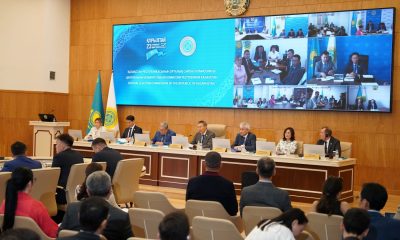
Kazakhstan: Central Election Committee reviews the results of the nomination of candidates for the deputies of Kurultai
-
South Caucasus8 hours ago
The South Caucasus at a historic turning point: Between lasting peace and renewed confrontation
-
 Aviation/airlines4 days ago
Setting a new benchmark in premium travel