EU
Kazakhstan: 2050 modernization strategy


By Colin Stevens.
This month (January 2014), Kazakhstan's leadership declared its most ambitious strategic plan up to the middle of the 21st century, intending Kazakhstan to join the 30 most-developed world economies. Similar long-term strategies are followed by the county’s neighbours – China, Malaysia and Turkey.
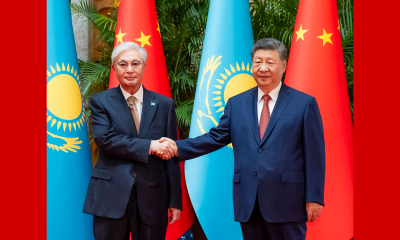
"Forthcoming decades will bring many well-known challenges, as well as numerous unexpected situations, new crises in global markets and world politics," said President Nursultan A. Nazarbayev (pictured), addressing the nation on 17January: "There will be no 'easy ride' in the 21st century."
 Although the concept of a ‘developed country’ is under continuous modification, there are certain indicators to define this category - the Organisation for Economic Cooperation and Development (OECD) represents the basis. They are 34 economies producing more than 60% of global GDP. Brazil, China, India, Indonesia, Russia and South Africa are on the doorstep of joining, manifesting high investment rates, research and innovation achievements, high productivity and considerable share of small and medium enterprises, all resulting in high living standards.
Kazakhstan is looking forward to apply the OECD standards, persuing its own economic long-terms plans to reach 4% GDP growth, developing knowledge-based economy to raise non-oil exports up to two thirds. Within this framework, the accents are placed on acceleration of industrial and innovative methods in traditional mining sectors, engaging knowledge-based production using the latest scientific achievements in electronic, technologies, telecommunications and equipment.
Next to the traditional mining sector, the reform is awaiting agriculture to shift from large-scale to medium and small enterprises, providing financing resources to entrepreneurs directly, without intermediaries - farmers will receive more protection in a system of guarantees and insurances. With its vast steppa, ideal for cattle grassing, Kazakhstan has a natural richness to become a leading meat- and dairy-products exporter in the region.
Its knowledge/science-based economy is pillar of success however, to accelerate its modernization, the country needs to use the full potential of foreign direct investment (FDA).
"In co-operation with the foreign companies we need to set up design and engineering centres," Nazarbayev continued, inviting transnational companies operating in major oil, gas and mining facilities to establish profitable production in Kazakhstan, offering governmental support in providing favorable conditions for foreign businesses to produce equipment in Kazakhstan, instead of importing.
The spin-off production sites of large international companies have been welcomed to Nazarbayev University in Astana and ‘Alatau’ Information Technology Park in Almaty.
Inviting the West to co-operate, Kasakhstanies are not overlooking the advantages of their geographical location in finalizing the construction of the Western Europe-Western China corridor. Railways to Turkmenistan and Iran reaching the Persian Gulf are already in place, but infrastructures reaching the sea remain a challenge for the Central Asian state.
The giant Zhezkazghan-Shalkar-Beineu railway project will reach out to the Caspian from the west and the Pacific from the east.
The openness of the country translates not only into the infrastructures, but also in education, encouraging high-school graduates towards trilinguism, Kazakh, Russian and English, to ensure the country's integration into the global community.
And no less attention is being paid to the development of the judiciary, as the government is conscious of the necessity of creating the highest-standard legal system, guaranteeing entrepreneurs an efficient mechanism for dispute resolution within the context of the rule of law.
The first stage of the realization of the 2050 strategy is planned to be achieved by 2030: "This is feasible. South Korea and Singapore followed this path," said Nazarbayev. "Kazakhstanies will not miss this ‘window of opportunity’ in the XXI century."
Colin Stevens
Share this article:
EU Reporter publishes articles from a variety of outside sources which express a wide range of viewpoints. The positions taken in these articles are not necessarily those of EU Reporter. Please see EU Reporter’s full Terms and Conditions of publication for more information EU Reporter embraces artificial intelligence as a tool to enhance journalistic quality, efficiency, and accessibility, while maintaining strict human editorial oversight, ethical standards, and transparency in all AI-assisted content. Please see EU Reporter’s full A.I. Policy for more information.



ECR MEPs question the European Commission on cardiovascular health and diet promoting the Mediterranean diet as an alternative to ultra-processed foods as key to tackling obesity

Falling in love with the Maldives

Kurmuk gold project highlights Africa’s changing investment landscape

Chinese “leadership and coordination”

Britain’s leadership crisis is a symptom, not the disease

EU steps up international support for Palestinians with major initiative for Gaza's early recovery and stronger international coordination

Commission adds exemptions to rules on removability of portable batteries

Albania's Vlora airport standoff tests investor confidence as EU accession clock ticks

Burnham as PM? 'Wait and see'

Ban on destruction of unsold clothes and shoes enters into application

Survey on an EU Blueprint for intellectual property licensing and spinoff creation

Rule of law report strengthens EU democracy and fundamental rights

EU launches Ukraine defence industrial partnership, Drone Deal and disburses €1 billion for drones *

Setting a new benchmark in premium travel

Kazakhstan: Central Election Committee reviews the results of the nomination of candidates for the deputies of Kurultai

Statement by the Ministry of Foreign Affairs of the Republic of Kazakhstan

Kazakhstan reforms under scrutiny at Brussels Press Club round table

Japan should face up to history and contribute more to regional peace

Ambassador calls for 'speeding up' of co-operation between EU and Kazakhstan

Timur Turlov at Smart Moves Summit 2025: How chess can transform global education

Shevtsova’s case: Out-of-court sanctions dismantling trust in Ukrainian cause

The future of European transport

Trump Vs Trueman

US 'no longer' an 'unconditional ally' for Europe - MEP
-
 Italy3 days ago
ECR MEPs question the European Commission on cardiovascular health and diet promoting the Mediterranean diet as an alternative to ultra-processed foods as key to tackling obesity
-
 Tourism4 days ago
Falling in love with the Maldives
-
 China4 days ago
Kurmuk gold project highlights Africa’s changing investment landscape
-
 China-EU5 days ago
Chinese “leadership and coordination”